

Fighting Back Means Looking Beneath the Surface
Every attack on nonprofits right now is like the tip of the iceberg we can see.

While skimming through an old notebook, I found notes from a workshop I participated in with the Visionary Organizing Lab (VOL) in August 2019, when I was working at the Arcus Center for Social Justice Leadership at Kalamazoo College. The notes serve as a great follow-up to what I wrote about last week. The sector is changing, yet we’re too exhausted and unprepared to adapt at the pace required to win the war Trump has been waging on nonprofits. We’re losing said war, partly because we refuse to confront ourselves or take real action to shift power, wealth, and control. As I revisit these seven-year-old notes, I see that the workshop’s frameworks speak directly to this moment and can guide our journey ahead.
In the workshop, titled “Changing Ourselves and Organizations: Transformative Professional Development for Social Justice Professionals,” we focused on internal issues that social justice organizations often overlook. The VOL, inspired by Grace Lee Boggs, emphasizes that personal change is essential to transforming the world. Their message encourages us to live differently, fostering self-reliant communities and dignity-affirming organizations that value non-material needs—such as love, identity, recognition, and community—just as much as the needs for physical survival.
The purpose of the workshop was to recognize that before we can transform systems, we must be willing to transform ourselves and the organizations we work in. Our goals that day were to collectively develop a vision for our organization, use empowering tools to navigate conflict, reflect on what our organizational culture would look like if it truly aligned with our organizational vision, and articulate our personal purpose in our work.
Seven years have passed since I sat in that workshop, and what those years taught me is that the gap between how well we talk about internal transformation and how seldom we practice it is not an accident of busy calendars. It’s a habit, and crises deepen it. Right now, our organizations are consumed with bracing for whatever Trump has up his sleeve next, and the inward work understandably keeps sliding down the priority list, exactly when it matters most.
Entering Hard Conversations
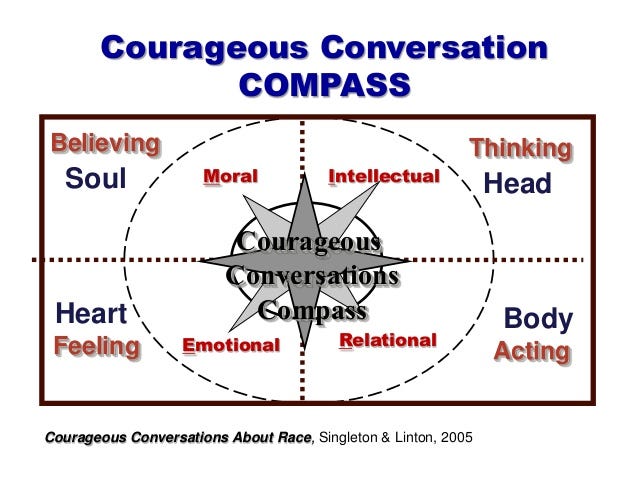
The facilitators introduced us to the Courageous Conversations Compass, which maps four ways people enter hard conversations:
Moral, through what we believe in our soul.
Intellectual, through what we think in our head.
Emotional, through what we feel in our heart.
Relational, through how we act with our body.
The nonprofit and philanthropic sectors favor an intellectual approach, as evidenced by the constant need to produce research reports, host webinars, and recycle data, all of which keep us informed but rarely translate into significant shifts in power. Yet the political and cultural moment we’re in challenges every aspect of this compass, touching the moral, emotional, and relational realms as well. We cannot simply lunch-and-learn our way through a landscape that requires us to feel, believe, and act.
Four Agreements for a Sector in Crisis
The workshop provided us with four agreements for courageous conversations, which I now share here as guiding principles to navigate this era:
Stay engaged. Burnout is driving many to leave this work, and I get why. Unlivable wages and unsustainable conditions make it understandable. That’s where VOL’s framework resonates deeply with me. Our sector has let workers down financially and emotionally, denying us the basic means to survive and the dignity, recognition, and community that make the work worthwhile. Remaining engaged shouldn’t mean exhausting ourselves but finding ways to maintain our connection to the work.
Experience discomfort. Real redistribution of power, wealth, and control will challenge those who currently hold all three. Philanthropy, in particular, has prioritized its own comfort as a prerequisite for action, but it cannot continue to operate this way if we’re going to survive and thrive in this era and beyond.
Speak your truth. For years, I kept critiques and questions to myself because, in the nonprofit industrial complex, honesty can jeopardize your job. Only after being laid off nearly two years ago, losing my financial stability and a job title I once valued, did I begin writing and speaking openly. This platform was created because I no longer needed to protect a paycheck. I found my voice through loss and separation from the echo chamber. But imagine a world where we don’t have to lose everything first. Imagine workplace cultures that promote open and honest communication without the fear of negatively impacting careers.
Expect and accept non-closure. This principle feels like the most important right now. The war-on-nonprofits argument suggests a definitive conclusion, hopefully one that leads to a day when we win. But organizing isn’t linear, and there’s a real possibility that things will get much worse before they improve. We’re asked to keep working without guaranteed closure, sowing seeds we may not see flourish. Embracing that lack of resolution requires discipline and commitment to the long haul.
Looking Beneath the Surface
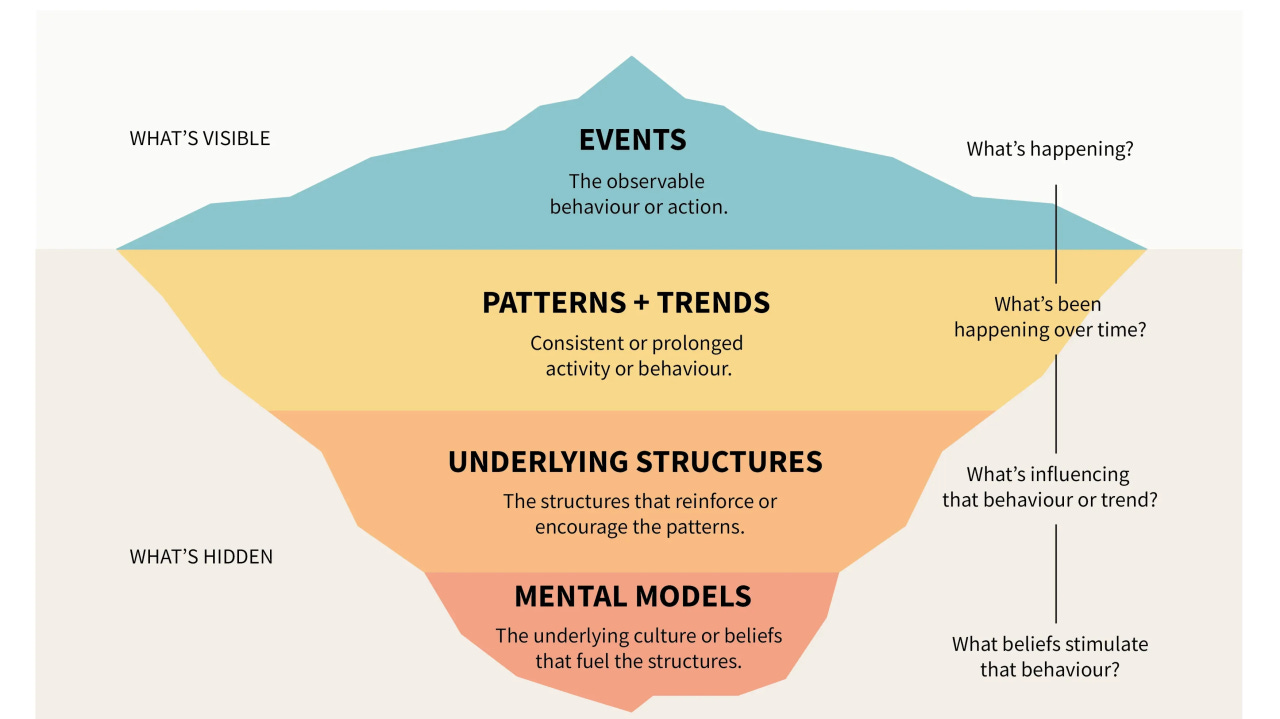
My notes also included the Iceberg Model as a tool to encourage systemic thinking and contextualize an issue within a broader system. An event, or a single incident, appears above the waterline. Below, there are patterns and trends, followed by underlying structures, and then the mental models that support it all. Ninety percent of the iceberg remains unseen beneath the surface. Therefore, effective solutions should focus on the entire system, not just the visible parts.
Every attack on nonprofits right now is like the tip of the iceberg we can see. The funding cuts, the investigations, the intimidation tactics, and all the other “events” we’ve endured are designed to pressure us into submission. Nonprofits and philanthropy keep responding at this level because it’s what’s visible and provokes immediate reactions.
But look one level down, and the internal patterns predate this administration. Chronic underfunding of the organizations and a lack of resources for the people closest to the work. Burnout being mistaken for personal failures rather than a systemic problem. Workers struggling financially, living paycheck to paycheck while foundation endowments continue to grow.
Beneath those patterns lie the structures that produce them. Labor exploitation and wealth extraction, the overinfluence of boards, and the professionalization of movement work and grassroots organizing, all maintained by the people who hold the money and therefore the power.
At the deepest level lie the mental models that hold everything above them in place. The intellectual quadrant of the compass is judged solely by measurable wins and tangible impact, while the moral, emotional, and relational dimensions of the work are seldom considered because they’re not as easily measured (or valued, to be honest). Scarcity mindsets limit our capacity to take risks, innovate, and imagine beyond the crisis in front of us. Power resides with those closest to wealth rather than those closest to the issues we aim to address.
Trump did not create that iceberg, but he’s using it to his advantage by steering us into it, hoping to crash and sink all the progress we’ve made toward becoming a country where the systemic barriers that marginalize oppressed communities are removed rather than reinforced. If all we do is temporarily patch the leaks after each collision, we will spend the next several years reacting rather than doing the deeper work of confronting the structures and mental models that made us so easy to sink in the first place.
Working to Be Free
The workshop ended with each of us individually defining our purpose in social justice work. In 2019, mine was to prioritize working toward freedom rather than remaining blissfully ignorant. Back then, this meant rejecting the comfort of ignoring how power operates within the institutions I was part of. Today, it involves using the insights gained from that awareness to speak boldly and honestly and to create spaces where other social justice workers can share their truths and exercise their full humanity.
The war on nonprofits aims to drain us until we can focus only on survival. This is why internal work must happen now, even amid the crisis, rather than waiting for calmer conditions (which probably won’t arrive any time soon). Purpose formed amid chaos can still serve as a north star. The organizations that endure this period and the individuals who remain resilient are those who understand their true social justice purpose.
As Grace Lee Boggs and her successors have emphasized, our task is never solely to fight the opposition. Instead, we must also choose to live differently and recognize the power of our full humanity, with our needs for love, identity, recognition, and community treated as central to the work rather than distractions from it.
So, I will leave you with the question:
What’s your personal social justice purpose, and what does it require of you during Trump’s war on nonprofits?
This was a worthwhile read. It's encouraging to see more creators discussing sustainable nonprofit leadership instead of just fundraising. We touched on a similar theme here and would genuinely appreciate any thoughts: https://thesemblereview.substack.com/p/making-every-dollar-matter
The non profit sector has to look within and the point on how the sector has (intentionally or unintentionally) prioritized its comfort is a hard truth for many organisations. Thank you for sharing these reflections.